$130M+
In ad spend, personally managed

HEMON
Architects of Direct Response
You have run the loop. Every step of it was reasonable. And eighteen months later, you are still the one chasing updates while the costs go up, not down.
Bad data, or no data at all. Nobody wrote down what worked, why it worked, or what it cost you to find out. So every agency, every media buyer, every 'new team member on your account' learned your business on your budget... then walked out the door with all of it.
That is what the engine above
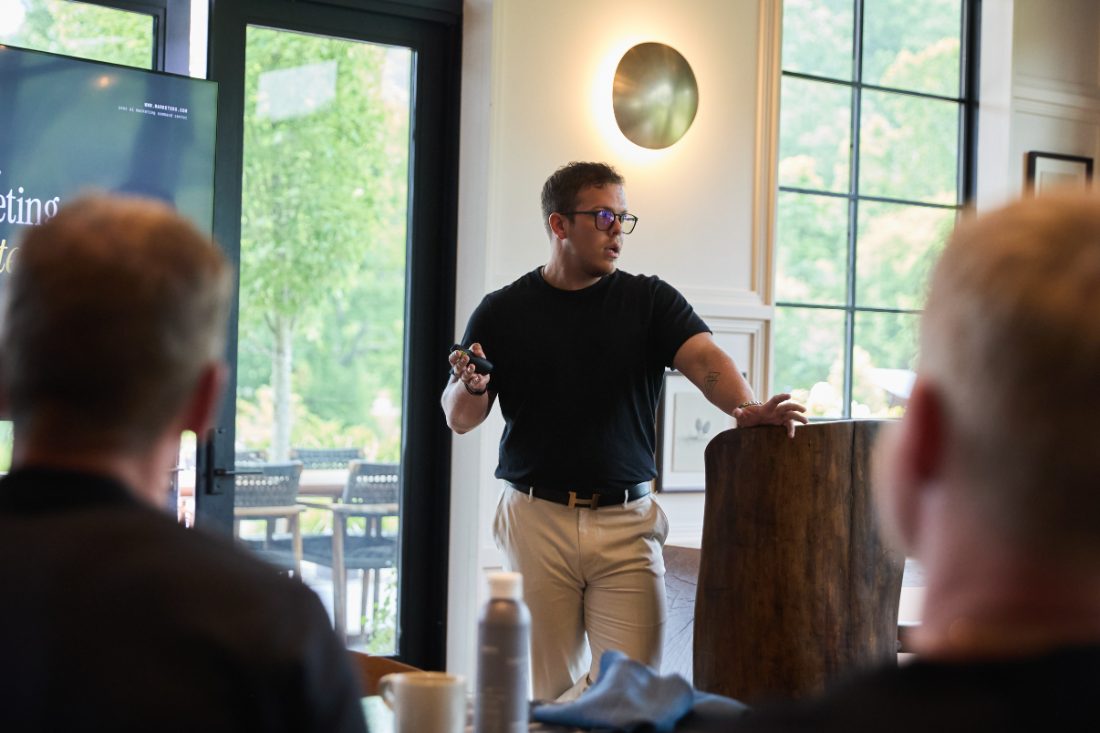
was built to end. And the man below
is the one who built it.
The loop: Creative · Offer ·
Funnel · Agency · RepeatThe cause: bad data, and no memory.
I spent a decade inside the agency industry. I scaled one past 170 people, personally managed more than $130 million in ad spend, and trained hundreds of the people running the agencies you have probably hired.
I also did the things agencies do. You know how the A-team pitches you and somebody else ends up running your account? When a bigger client came in, I moved my best strategist onto it and staged the handoff over sixty days so the smaller client would not notice. That email you sent three weeks in, the one that said 'something feels different, the recommendations feel generic'... I have received that email. I knew exactly why it was sent.
In January 2025 I stood in front of 300 agency owners and told them AI was going to out-market most of their teams, and that almost none of them would do anything about it. The talk is public. Watch what I said, then look around at what happened.
Then I went and did something about it myself. I left the industry, spent two years building the intelligence engine you just scrolled through, and came back with it.
Hemon is new. I am not. When you hire Hemon, you get me... personally, on your account. The engine is why I keep the client list small, and why small is enough.

Emails, ads, sales pages, scripts. All of it read, measured and kept. What your budget learns, you keep.
Their exact phrases, mined from reviews, surveys and sales calls, become the raw material. Verbatim, never paraphrased. Never our words. Theirs.
Checked against your brand voice, your audience and everything that has ever worked for you. The weakest part is named, and that part is fixed. Never the whole piece.
Every piece is tested for one thing above all: could anyone else in your category say this? If yes, it goes back. No cookie-cutter work survives that question.
Nothing in your account runs on autopilot, and there is no black box. Budgets, offers, launches: every trigger is pulled by a marketer, and every judgment call is written down, with the reason why.
On day one it reads everything you have ever run, so nobody is learning on your budget. By month six it knows which angles are fresh, which audiences are tiring, and which changes actually move your numbers.
Your history · Their words · The score · The copycat test · The decision · The compounding
Checkpoints, not opinions. Failure stops everything.
Hemon is a new agency, and we will not pretend otherwise. What we can show you is ten years of the founder's client work... and further down, a contract that puts the risk of the new agency on our side of the table.
Same brand, same holiday months, one year apart: $1.55M of revenue at 1.89 ROAS became $2.15M at 2.09 with us running ads. At seven-figure spend, where a decimal point is real money.
Cost per sale cut nearly in half in 60 days: $787 to $406. Lead cost down 46%. Profit up 35%. Same offer, same market.
The ask was $2,000 a day at breakeven. The result was $4,000 a day at a 1.57 return.
He scaled me from around $20,000 a month in ad spend to $400,000 a month. He was there when my company became an 8-figure company, and he was very instrumental in that.Tanner Chidester · CEO, Elite CEOs
“We did $213,000 in 2019.Clients & Community · High-ticket business coaching
We did $2,500,000 cash in 2020.”
“I can tell you personally, Ashton is a genius.”Dan Henry · CEO, GetClients.com
Also on the recordJay Shetty · LadyBoss · Cardomax · Christian Planner.
No juniors learning on your budget, no account-manager roulette, no strategist getting moved to somebody bigger. Ashton runs every account personally, with the engine underneath, and the client list stays small on purpose. When it is full, it closes.
Six-month term. If we are not performing after three full months, you can leave at the end of month four with fourteen days notice. And everything the engine learned on your account... the data, the winners, the reasons why... leaves with you, not with us.
You answer real questions about your business. I read every word before we ever speak, so the first call starts at the diagnosis instead of introductions. And if I cannot help, I will tell you that plainly... and tell you where I would go instead.
The performance-out is written into the contract, not implied on a phone call. If the numbers do not move, the door is drawn right there... and you walk through it with everything your budget learned.
An agency, run personally by its founder. The engine measures everything and decides nothing. You will always know exactly who is on your business, because it is the same person whose name is on the letter above.
Ashton does. Not a pitch team that hands you off after the contract is signed. The client list is small enough that the person you talk to before you sign is the person running your ads after.
Every month you get the full breakdown: every test we ran, every campaign, every result, and the judgment calls behind them, written down with the reason why. If you have ever suspected an agency's report was activity dressed up as results, this is the opposite. It reads like a working history of your account... and every page of it is yours to keep.
You do. Every result, every winner, every lesson your ad spend paid for is written down and belongs to you. It does not walk out the door with an employee, an agency, or us.
Because the model is the founder's attention multiplied by the engine, not juniors multiplied by headcount. There is a hard cap on accounts at any given time, and when the list is full, it closes until a spot opens.
Your application gets read before we ever speak. If you are a fit, you book a call on the spot, and that call starts at what is broken instead of twenty minutes of introductions. If you are not a fit, the application tells you plainly, and points you at what I would do in your position.
Six months. If we are not performing after three full months, you can leave at the end of month four with fourteen days notice. Everything learned on your account leaves with you either way.
Invent a testimonial. Manufacture a statistic. Name a winner before the data can support one. Put a dollar behind a piece a competitor could sign. The engine is built to show us gaps, not to fill them with confident guesses, and every refusal is written down too.
The application asks real questions: your sales cycle, how many ways your funnel collects cash, when your landing page was last tested, who has to approve a change. It takes about four minutes, and the better your answers, the better the first call.

Not ready for a conversation? Read the field report on the 7 things that break underneath a business at your next level →